


Home Blog Skin Rejuvenation & Lasers ResurFX Laser Resurfacing: Downtime, Results and the Sun-Damage Question
Instagram: @DrKoroshBorhani·@CristinaBorhani_NP·@skinbio.co
Written by Cristina Borhani, MSN, NP. Medically reviewed by Korosh Borhani, D.O., board-certified emergency physician and Medical Director of Skin Bio. Last reviewed September 17, 2026. Instagram: @CristinaBorhani_NP
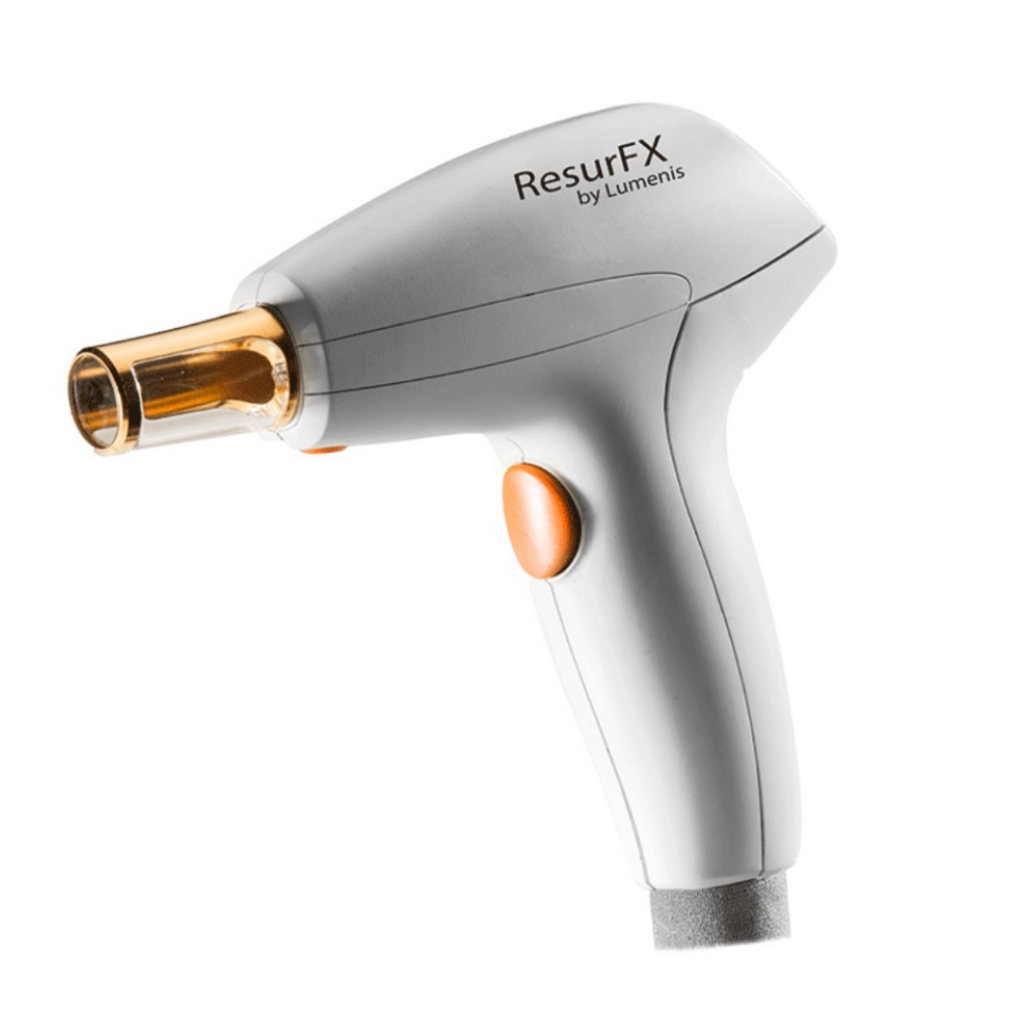
The ResurFX laser is the treatment I reach for most often when someone sits down and says their skin looks tired but they cannot afford to disappear for two weeks. It is a non-ablative fractional laser, which is a technical way of saying it heats the deeper layer of your skin without taking the surface off.
That distinction is the whole reason it exists, and it is also the reason it has limits. I want to walk through both, because the marketing around lasers in Los Angeles tends to describe every device as if it does everything.
The short version
The handpiece fires thousands of microscopic columns of 1565 nm energy into your skin. Water in the dermis absorbs that wavelength and converts it to heat. The heat creates tiny zones of controlled injury, each surrounded by untouched tissue, and your body responds by recruiting fibroblasts and laying down new collagen over the following weeks and months.
The key word is fractional. Only a fraction of the treated area receives energy at a time. The untreated skin in between is what lets you heal in days instead of weeks, because the barrier is never removed.
Compare that to an ablative laser, which vaporizes the surface. Ablative gets you more dramatic change in one pass and costs you two weeks of genuine downtime, weeping skin and a real infection risk. ResurFX trades intensity for recoverability, and asks you to do it several times.
| Concern | Realistic expectation |
|---|---|
| Rough texture, dullness | Responds well; usually the first thing patients notice |
| Enlarged pores | Measurable improvement over a series; one published study found about a 29 percent reduction in pore count after five sessions |
| Fine lines, crepey texture | Gradual softening over months as collagen remodels |
| Acne scarring | Improvement over a series; boxcar and rolling scars do better than deep ice-pick scars |
| Surgical and traumatic scars | Good responder, particularly when treated early |
| Stretch marks | Reasonable evidence for improvement, though it takes a series |
| Sun damage and brown patches | Helps, but it is not the best tool — see below |
| Deep folds, sagging | No. This is not a tightening or volumizing device |
Two honest caveats. First, wrinkles are the slowest thing to respond, and the improvement is gradual rather than dramatic. Patients who come in wanting their nasolabial folds gone are going to be disappointed by any laser, and I would rather say that in the consultation than after four sessions.
Second, if the problem is laxity rather than surface quality, you want a different device. Morpheus8 works at a different depth with radiofrequency and does a different job. They are not competitors so much as tools for different problems, and plenty of patients end up doing both at different times.
This is the part that matters most in Southern California, and it is where I do the most saying no.
ResurFX is absorbed by water, not by pigment. That makes it safer across a wider range of skin tones than pigment-targeting devices, and the handpiece has contact cooling that limits heat buildup in the epidermis. It will improve overall tone and the texture side of photoaging.
But for discrete brown spots from sun exposure, IPL is usually the better tool, because it targets pigment directly. If sun spots are your main complaint, I will often start you there instead.
Melasma is the one to be careful with. Melasma is heat-sensitive, and aggressive resurfacing can make it worse rather than better. If you have melasma, the plan starts with sun protection and topical therapy, and any laser comes later, at conservative settings, with the understanding that we are managing a chronic condition rather than curing it. Anyone who promises to clear your melasma in three sessions is telling you what you want to hear.
For deeper skin tones, Fitzpatrick IV through VI, this laser is usable but the settings come down and I test a small area first. The risk being managed is post-inflammatory hyperpigmentation, which is very treatable but takes months to fade and is entirely avoidable with conservative settings.
Not sure whether your skin needs resurfacing, pigment treatment, or neither?
A consultation sorts that out in fifteen minutes, and sometimes the answer is that you should spend your money on sunscreen and a retinoid first.
We numb first with a topical anesthetic and leave it on for thirty to sixty minutes, then clean the skin thoroughly. That wait is not padding. Numbing cream applied five minutes before a laser pass does very little, and rushing it is the main reason people describe these treatments as unbearable.
During treatment most people describe a hot prickling sensation that builds as we pass over an area. The handpiece has built-in cooling, and there is a cold-air option. It is uncomfortable rather than painful, and it is over quickly on a face.
Immediately afterward you will be pink and feel like you have a sunburn, and there is usually some swelling for the first day or two, most noticeably under the eyes.
For the first forty-eight hours I want you on a gentle cleanser and gentle skincare, and nothing active. No retinoids, no acids, no vitamin C, no scrubs. Your barrier is busy. Give it two days before you ask it to do anything else.
I typically plan on three sessions spaced about a month apart. Judging the result after one session is like judging a haircut halfway through.
Expected effects include redness, swelling, a sandpaper texture for several days, and occasionally small pinpoint bruising. Less common but real: post-inflammatory hyperpigmentation, prolonged redness, reactivation of cold sores, and, rarely, blistering or scarring if settings are wrong for the skin being treated.
I do not treat you if you have an active infection or active acne in the treatment area, if you are pregnant, if you have used isotretinoin recently, or if you have a tan. A fresh tan is a real contraindication, not a scheduling preference — treating tanned skin is how you get pigment problems. In Los Angeles this is a genuine conversation every summer.
If you have a history of cold sores, tell me, because we pretreat with an antiviral. If you have melasma, see above. If you keloid, we talk carefully before proceeding.
I typically recommend three, spaced about a month apart. Scarring and stretch marks sometimes take more than that.
Redness typically lasts two to five days, with swelling in the first day or two. Many patients are back in makeup within a couple of days.
With topical numbing, most patients describe it as a hot prickling sensation rather than pain. The handpiece cools the skin as it works.
It is generally safer than pigment-targeting lasers because the 1565 nm wavelength is absorbed by water rather than melanin. For Fitzpatrick IV through VI we use conservative settings and test an area first.
Not if you are tanned. Treating recently sun-exposed skin raises the risk of pigment problems, so we either wait or plan treatment for a period when you can genuinely stay out of the sun.
Different problems. ResurFX addresses surface quality, texture, pores and scarring. Morpheus8 works deeper with radiofrequency and targets laxity. Which one you need depends on what is actually bothering you.
Sources and further reading
Follow along on Instagram: @CristinaBorhani_NP and @skinbio.co
This article is educational and is not individual medical advice. Laser treatment requires evaluation by a licensed provider, who should assess your skin type, history and goals before any device is used. If you would like to discuss whether resurfacing is appropriate for you, get in touch.

Consultations at Skin Bio are with a physician or nurse practitioner — not a salesperson. We’re in Calabasas and see patients from across the greater Los Angeles area.
Or call 818.222.9797