


Home Blog News & Events The Many Hats I Wear Running a Cosmetic Dermatology Practice
Instagram: @DrKoroshBorhani·@CristinaBorhani_NP·@skinbio.co

Written by Cristina Borhani, MSN, NP. Medically reviewed by Korosh Borhani, D.O., board-certified emergency physician and Medical Director of Skin Bio. Last reviewed October 2, 2026.
Nobody tells you that running a medical practice is mostly not the part you trained for. I spent years becoming a good injector. I have spent the last several years becoming a passable bookkeeper, a reluctant payroll administrator, and someone who knows more about commercial lease terms than she ever wanted to.
I am writing this because people ask me about it constantly — nurse practitioners and physician assistants thinking about going out on their own, patients who are curious what happens between appointments, and friends who assume owning a practice in Calabasas is mostly glamorous. Some of it is. Most of it is a Monday morning or a Friday afternoon spent reconciling an invoice.
The short version
I have been practicing as a dermatology nurse practitioner for over sixteen years. My first eight were in medical and cosmetic dermatology, which is where I learned to inject and, more usefully, learned what bad outcomes look like and how they happen.
My husband, Korosh Borhani, D.O., and I started the practice in Calabasas in 2018. It became Skin Bio in 2020, when I bought out my original partner and we rebuilt the practice with cosmetic dermatology and regenerative medicine as pillars. The name change was not a rebrand exercise. It marked the point where the practice became ours to shape.
I keep a running joke with our practice manager that my title changes about nine times a day. It is not really a joke.
Strategist/CEO. Deciding what we offer and, far more importantly, what we decline to offer. Every month there is a new device, a new peptide, a new modality with a slick rep and a financing plan. Most of them are not good enough yet. Saying no to a six-figure machine is a clinical decision disguised as a financial one.
Finance/CFO. Cash flow, product costs, forecasting, the arithmetic of whether a treatment is worth the room time it occupies. Aesthetics has brutal inventory economics — product expires, devices depreciate whether you use them or not, and a slow January still has a lease payment attached.
Operations/COO. Scheduling, room turnover, supply chain, how long a treatment takes versus how long we blocked for it. When patients say a practice feels calm, what they are responding to is operations working properly.
Payroll and risk. The two least glamorous and most consequential. Payroll because people’s lives depend on it being right and on time. Risk because in California this is a medical practice, not a spa, and the rules about who may treat, who must evaluate a patient first, and who may own are not suggestions. Korosh wrote about those rules in detail in his checklist for choosing a med spa, and they shape our structure as much as they shape a patient’s choice.
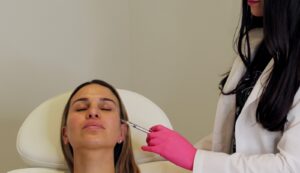
Injector/Dermatology FNP-MSN. The actual job. Several days a week, in the treatment room, doing the thing I am best at.
Educator and mentor. Training, teaching, and the mentorship program we run for students heading toward medicine. Creating a culture at Skin Bio where employees actually want to be. This one has become the part I think about most.
Community face. Director of Finance on the Executive Board of the Calabasas Chamber of Commerce, local events, partnerships, showing up. In a town this size, the practice’s reputation and my personal one are the same object.
And then the long tail. Contractor and Interior Decorator for the buildout. Blog writer. Event coordinator. E-commerce manager. Website manager. None of which I trained for and all of which are now mine.
Here is the thing I did not understand at the start: the clinical work funds everything else, so protecting it is the whole job.
If I let the administrative side expand to fill all available time, I am a worse injector. Tired, rushed, treating patients between vendor calls. And the quality of the clinical work is the only durable asset the business has. Devices get superseded. Marketing channels change. What does not change is whether patients trust the person holding the syringe.
So the discipline is treating clinical time as the fixed point and making everything else fit around it, rather than the reverse. I am not always good at this. But I know when I am failing at it, which took a few years to learn.
Curious what a physician-led practice actually feels like from the chair?
Every new patient is evaluated by a physician or nurse practitioner before any treatment, and plenty of consultations end with us recommending less than you came in for.
The version of this article where I did it all myself would be a lie, and a boring one.
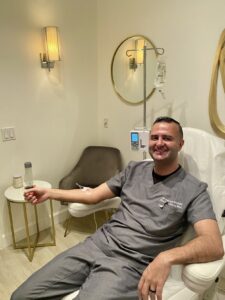
Dr. Borhani is our Medical Director and Chief Medical Officer, and he owns compliance. He is a board-certified emergency physician who still works shifts in Los Angeles-area emergency departments, and he handles the regenerative and metabolic side of the practice — hormones, weight management, IV therapy, lab work. He also does the physician evaluations and sets the standard operating procedures and protocols. Having a practicing emergency physician own the question “what happens if something goes wrong” is not a marketing line; it changes how the rooms are stocked.
Melanie, our practice manager, runs the day to day: HR, vendors and reps, and the whole shape of the patient experience from the first phone call to the follow-up. If you have ever been to a practice where the front desk seemed to know you, that is a designed thing, and a design by someone. Designing a luxury experience for every patient, and constantly improving upon it.
Beyond that we have a bookkeeper, a CPA, and a marketing director. Each of those is a function I handled badly for a while before admitting that doing it badly was more expensive than paying someone to do it well. That is probably the single most useful lesson in this article.
Learn the legal structure before you sign anything. In California, a practice offering injectables and medical lasers is the practice of medicine. There are real rules about ownership, about who may evaluate a patient before treatment, and about the relationship between a physician and other licensed clinicians. Understand them properly, with an attorney, before the lease and not after.
Your clinical skill is necessary and not sufficient. Being the best injector in the building does not make you able to read a profit and loss statement. Those are unrelated skills and you need both.
Hire for the things you are worst at, earlier than feels comfortable. The bookkeeping I was doing myself in year one cost me more in errors and lost clinical hours than a bookkeeper would have cost.
Decide what you will not do, and write it down. Not every treatment, not every patient, not every opportunity. The practices that get into trouble are usually the ones that never drew that line.
You will be the most expensive employee you have. Not in salary. In opportunity cost. Every hour you spend on a task someone else could do is an hour not spent on the thing only you can do.
Education has become the direction I want to move in. I run a mentorship program for students heading toward medical careers, and the questions they ask are rarely about technique. They are about how any of this works — how you build something, how you decide, how you keep the clinical standard intact while running a business that has to make money.
There is not much honest writing about that. Most of what exists is either a course being sold to you or a highlight reel. This is neither. It is just an accounting of what the job actually involves, from someone still doing it, in a town I am glad to practice in. You can read more about us if you want the formal version.
Clinical skill, business literacy, and a legal structure that complies with your state’s rules. In California, injectables and medical lasers are the practice of medicine, which shapes who may own the practice, who may treat, and who must evaluate a patient first.
California restricts ownership of medical practices. Nurse practitioners and other licensed professionals may hold a minority interest in a professional medical corporation, but the practice must be physician-owned and physician-run. This is worth reviewing with a healthcare attorney rather than a general business advisor.
In my experience, roughly a third. The rest is operations, finance, compliance, staffing, vendors and marketing. Anyone who tells you otherwise is either not running the business side or not running it well.
Skin Bio is owned and run by Korosh Borhani, D.O., a board-certified emergency physician and our Medical Director, and me, Cristina Borhani, MSN, NP. We started the practice in 2018 and it became Skin Bio in 2020.
Protecting clinical time. Administrative work expands to fill whatever space you give it, and the quality of the treatment you deliver is the only thing that durably keeps a practice open.
Sources and further reading
This article describes my own experience running a practice and is educational only. It is not legal, financial or business advice, and it is not individual medical advice. Anyone considering opening a medical practice should consult a healthcare attorney and an accountant in their own state. For treatment questions, get in touch.

Consultations at Skin Bio are with a physician or nurse practitioner — not a salesperson. We’re in Calabasas and see patients from across the greater Los Angeles area.
Or call 818.222.9797