


Home Blog Wellness & Hormones NAD+ Drips: What I Tell Patients Before They Book One
Instagram: @DrKoroshBorhani·@CristinaBorhani_NP·@skinbio.co

Written by Korosh Borhani, D.O., board-certified emergency physician and Medical Director of Skin Bio. Clinically reviewed September 28, 2026. Instagram: @DrKoroshBorhani
I get asked about NAD+ more than almost anything else we do at Skin Bio. At the gym, at dinner, in the ER break room. So let me write down what I tell people, the same way I’d say it if you were sitting across from me in the office. If you want my take on IV therapy in general, I already wrote that one here.
The short version
First, it’s not a peptide and it’s not a vitamin. NAD+ is a coenzyme, a helper molecule your cells use to move electrons around when they burn fuel. It shows up in hundreds of reactions, which is exactly why you can hang any promise you want on it.
It’s not new, either. The IV version goes back to the early 1960s, when a doctor in Seattle used it for alcohol withdrawal and noticed that running it in too fast gave people headaches and shortness of breath. That’s still the most useful thing anybody has figured out about an NAD+ drip.
Your NAD+ does fall as you get older. I’m 43, so I’ve thought about this one. You don’t stop making it. What changes is that the enzymes that use it up, your DNA-repair enzymes and an immune enzyme called CD38, work harder as you age and as you get more inflamed. Same supply, bigger demand. That’s the argument for topping it off. It’s also why I’m careful about what I promise. Adding more to a system that’s burning it faster isn’t the same as fixing the burn.
When someone has a real deficit, the results are real. Niacin improved strength in people with a mitochondrial muscle disease. Nicotinamide riboside improved neurologic scores in a rare DNA-repair disorder. Sick people getting better. That’s medicine.
In healthy adults, the oral precursors reliably raise the NAD+ level in your blood. What the trials haven’t shown yet is the stuff people hope for, like more strength or better endurance. The number goes up. The person, so far, is harder to measure.
For the IV version, the data is younger. A 2019 pilot study ran 750 mg into people over six hours, and the NAD+ level in their blood didn’t move for the first two hours while the breakdown products showed up in the urine. My read: it gets taken apart in the bloodstream, and where the pieces go, we don’t know yet. There’s no big randomized trial. What I do have is a lot of patients who come back and tell me about more energy, sharper focus, and a faster bounce back after travel, a hard week, or a string of night shifts. I’ve used it myself, and so have a few of my ER physician friends, after night shifts and the constantly shifting schedules that come with the job. So I take those reports seriously. I still tell everyone to track how they feel. Your own before-and-after is the study that matters to you.
Remember the doctor in Seattle. Run NAD+ in fast and you get chest tightness, flushing, cramping and nausea. I’ve seen it. It’s all about the rate, which is why we run it slow and set the rate for you, not for the schedule. Most people read, work, or fall asleep.
Two situations where I’ll tell you to talk to your specialist before you book. Active cancer or chemotherapy, because NAD+ feeds DNA repair and chemo works by damaging the DNA of fast-dividing cells. And known plaque in your arteries, because a couple of 2025 mouse studies found NAD+ boosters made atherosclerosis worse. Mice aren’t people, but that’s a conversation for your cardiologist, not for a menu.
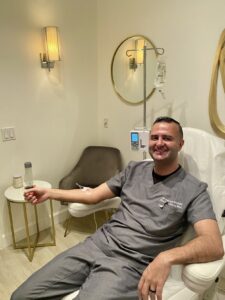
A real consultation first. Pharmacy-compounded NAD+ on a prescription, not a vial off the internet. A slow drip, at a rate set for you. We also do it as a subcutaneous shot, a few minutes instead of a few hours, for people who want a smaller dose more often or can’t sit still. That’s me, by the way. Which one fits is part of the conversation.
If you have a condition tied to low NAD+, we’ll talk about whether it makes sense. If you’re healthy and want to see what it does for you, that’s a fair experiment, as long as you’re already doing the boring things that actually move the needle. Sleep. Protein. Lifting. Blood pressure and cholesterol handled.
The research on IV NAD+ is still early. I’d rather tell you that here, in writing, than have you find out in the chair. Come in, we’ll run it slow, and you’ll leave knowing exactly what you did and didn’t sign up for.
The oral precursors reliably raise blood NAD+ in studies, and a lot of my patients report more energy and focus after a drip. There’s no big randomized trial of IV NAD+ yet, so I tell people the research is still early and to track how they feel.
Depends on the dose. We run it slowly and set the rate for you, because slower is safer and a lot more comfortable. Bring a book or your laptop. If hours in a chair isn’t your thing, ask about the subcutaneous shot.
Anyone with active cancer or on chemotherapy, and anyone with known plaque in their arteries. Bring it up at your consultation and we’ll sort it out together.
Sources and further reading
Follow along on Instagram: @DrKoroshBorhani and @skinbio.co
This article is educational and reflects the author’s clinical opinion. It is not medical advice for any individual. NAD+ therapy requires evaluation by a licensed medical provider; risks vary with your health history.

Consultations at Skin Bio are with a physician or nurse practitioner — not a salesperson. We’re in Calabasas and see patients from across the greater Los Angeles area.
Or call 818.222.9797