

Home Blog Injectables Preventative Botox in Your 20s and 30s: Worth It or Marketing?
Instagram: @DrKoroshBorhani·@CristinaBorhani_NP·@skinbio.co
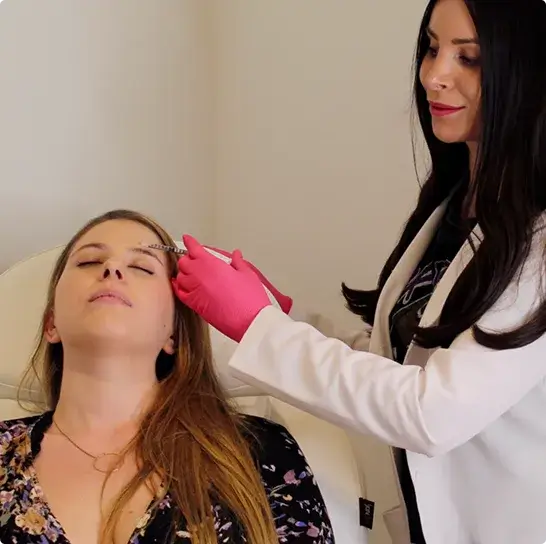
Written by Cristina Borhani, MSN, NP. Medically reviewed by Korosh Borhani, D.O., board-certified emergency physician and Medical Director of Skin Bio. Last reviewed September 17, 2026. Instagram: @CristinaBorhani_NP
A twenty-four-year-old sat in my chair last month and asked whether she was already too late to start preventative Botox. She had no lines. Not at rest, not when she raised her brows, not when she frowned. Somebody on the internet had convinced her that her face was a problem she was behind on solving.
So let me answer the question directly, because I think the honest answer is more interesting than either the marketing or the backlash. Preventative Botox is partly real and partly sold to people who do not need it yet. And the way it is usually dosed is, in my opinion, the wrong way to do it.
The short version
The claim rests on a real distinction. Dynamic lines appear when a muscle contracts. Static lines are there when your face is at rest. Over years of repeated folding, dynamic lines become static ones, the way a piece of paper folded in the same place a thousand times keeps the crease.
The preventative argument is that if you reduce that repeated folding before the crease sets, the static line forms later or less deeply. That is a reasonable mechanism. It is not a mystical claim.
What it does not mean is preventing aging. A neurotoxin does nothing for volume loss, skin laxity, bone remodeling, or sun damage, and those account for most of what people actually notice when they say a face looks older. Treating your glabella at twenty-eight will not keep your midface full at fifty.
Here is where I want to be careful, because this is the part that gets overstated in every ad you have seen.
The study everyone cites is a comparison of identical twins published in 2006, followed over thirteen years, where one sister was treated regularly and the other twice. The treated twin had noticeably fewer forehead and glabellar lines. It is genuinely interesting and the photographs are striking.
It is also a case report on two people. That is not the same thing as a clinical trial, and anyone presenting it as proof is overselling. A more recent systematic review found that early treatment appears to reduce muscle hyperactivity and may delay dynamic lines from becoming static ones, which is supportive but measured. The Cleveland Clinic’s summary is blunter: there is not much evidence that preventative treatment works.
My read, after years of injecting: the mechanism makes sense, the long-term data is thin, and the honest position is that it probably helps with expression lines specifically and definitely does not do the other things it gets credit for.
Not at a birthday. At a finding.
The signal I look for is a line you can see at rest that you could not see a year ago. Stand at a mirror in good light with your face completely relaxed. If there is a faint shadow between your brows or across your forehead that stays when you stop moving, that line is beginning to set, and that is the window where treatment has something to prevent.
For most people that is late twenties to early thirties. For someone with a strong frown habit or very expressive brows it can be earlier. For someone with excellent sun protection and a calm forehead it can be much later.
If your face is smooth at rest and you are asking about prevention because of something you saw online, my advice is sunscreen and a retinoid, and come back when there is something to treat. I say this to people every week and nobody has ever been upset about it.
Want an honest read on whether you need this yet?
Plenty of consultations here end with a skincare plan and a “come back in two years.” That is a legitimate outcome, and it is free to find out.
“Preventative Botox” almost always arrives bundled with “baby Botox” — a few units sprinkled around, marketed as subtle and beginner-friendly. I understand why it sells. I do not dose that way, and here is my reasoning.
The doses in the clinical trials are the doses the duration data came from. When you read that a treatment lasts three to four months, that is three to four months at the studied dose. Cut it in half and you do not get half the result for half the price. You typically get a weaker result that fades sooner, and sometimes an uneven one, because partially weakening a muscle does not distribute itself neatly.
What follows is predictable. The result softens at six or seven weeks instead of twelve, so you book a touch-up, then another, and you end up injected more frequently in smaller increments, chasing a result you never fully got. Botox’s own labeling advises the lowest effective dose at the longest feasible intervals, and a schedule that has you back every seven weeks is working against that, not with it.
So my position is this: the trend is roughly right about when and wrong about how much. If you are genuinely at the stage where a line is setting, you are at the stage where a proper dose is appropriate. If a tiny dose is all you think you need, that is usually a sign you are not there yet. I would rather tell you to wait a year than take your money for something that will disappoint you. If you want the detail on what a proper dose looks like by area, I wrote about that in our dosing guide.
Starting at twenty-five instead of thirty-two means an extra seven years of treatments, three or four times a year, indefinitely. That is a real financial commitment, and it is worth doing that arithmetic before you begin rather than after.
There is also the question of what long-term muscle weakening does over decades. Treated muscles do weaken with disuse over time, which is part of why long-term patients often need slightly less. Whether that is purely a benefit across thirty or forty years is not something anyone has good data on, because the treatment has not existed long enough in young patients to know.
I am not raising that to frighten anyone. I am raising it because “start as early as possible” is an argument being made by people selling the product, and it deserves at least one skeptical question.
Botox is a prescription medication with a boxed warning about the distant spread of toxin effect. Common effects include bruising, headache, and temporary brow or eyelid heaviness, particularly if the forehead is treated without the glabella. Asymmetry happens and is usually correctable at the two-week check.
It is contraindicated with an infection at the injection site or a known hypersensitivity to any botulinum toxin preparation. I do not treat patients who are pregnant or breastfeeding. Neuromuscular conditions such as myasthenia gravis, Lambert-Eaton syndrome or ALS require a conversation with your neurologist first.
And the non-medical category, which matters more in this age group than any other: if what is driving the appointment is a filter, a bad photo, or a comment someone made, that is worth sitting with before anyone injects anything into your face. I would rather have that conversation than skip it.
When you can see a line at rest that was not there before, which for most people is the late twenties to early thirties. Age alone is not the trigger; the finding on your face is.
For expression lines specifically, the mechanism is sound and the evidence is modest and supportive. It does nothing for volume loss, laxity or sun damage, which cause most of what people describe as looking older.
In my experience, no. Lower doses generally mean shorter, less predictable results and more frequent visits. If you are ready for treatment, a proper dose is the more sensible starting point.
Most long-term patients need the same or slightly less, because treated muscles weaken somewhat with disuse. The bigger commitment is duration, not dose.
Muscle movement returns over three to four months and lines resume forming at their natural rate. You do not end up worse than if you had never started.
Botox Cosmetic is approved for adults, and the safety profile does not change with youth. Whether it is appropriate for you is a separate question from whether it is safe, and it requires an evaluation by a licensed provider.
Sources and further reading
Follow along on Instagram: @CristinaBorhani_NP and @skinbio.co
This article is educational and is not individual medical advice. Botox is a prescription medication, and treatment requires evaluation by a licensed provider. If you would like to discuss whether it is appropriate for you, get in touch.

Consultations at Skin Bio are with a physician or nurse practitioner — not a salesperson. We’re in Calabasas and see patients from across the greater Los Angeles area.
Or call 818.222.9797