


Home Blog Injectables How Many Units of Botox Do I Need? A Dosing Guide by Area
Instagram: @DrKoroshBorhani·@CristinaBorhani_NP·@skinbio.co
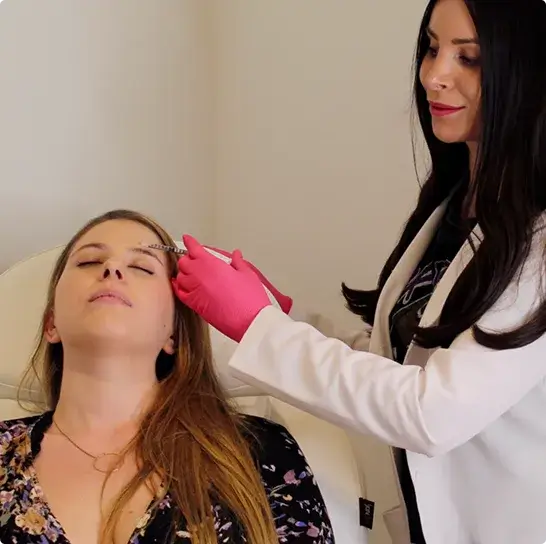
Written by Cristina Borhani, MSN, NP. Medically reviewed by Korosh Borhani, D.O., board-certified emergency physician and Medical Director of Skin Bio. Last reviewed September 17, 2026. Instagram: @CristinaBorhani_NP
It is the question I get more than any other, usually before a patient has finished sitting down. How many units of Botox do I need? Fair question. That number determines your result, how long it lasts, and what you pay, and almost nobody explains where it comes from.
The real answer depends on your anatomy, your muscle strength, and what you want your face to still be able to do. But “it depends” is a non-answer. So here is how I actually think about dosing, area by area, and why I dose the way I do.
The short version
This trips up almost everyone. A unit of Botox is not equivalent to a unit of Dysport, Xeomin, Jeuveau, or Daxxify. These products are not interchangeable and their units do not convert on any simple ratio. Dysport, for instance, is typically dosed at roughly two to three times the unit count for comparable effect.
So when you are comparing prices, ask which product is being used before you compare per-unit cost. Otherwise you are comparing dollars per ounce to dollars per pound. This is worth knowing in a market like Los Angeles, where per-unit pricing gets advertised aggressively and the product name is often in the fine print.
I am brand loyal, and I will tell you why. Botox has the longest track record and the deepest body of clinical research of any neurotoxin available. It has been studied in more patients, across more indications, over more years than anything else in the category, and it currently holds four FDA-approved aesthetic indications: frown lines, forehead lines, crow’s feet, and platysma bands.
That matters for one practical reason. When a product has been studied that thoroughly, I know what to expect from it. Onset window, duration curve, dose-response, safety profile at specific doses in specific muscles. Predictability is not a small thing when you are injecting someone’s face.
Newer toxins may well prove excellent, and some already look promising. I would still rather give you the most predictable result available than the newest one.
Below are the doses from the FDA-approved labeling, which come directly out of the clinical trials. Below that are the areas treated off-label, meaning the dose comes from published literature and practice experience rather than an FDA indication. Off-label use is standard and appropriate in aesthetics, but you should know which is which.
| Area | Labeled dose | How it is placed |
|---|---|---|
| Frown lines (glabella, the “11s”) | 20 units | 4 units into each of 5 sites |
| Crow’s feet (lateral canthal lines) | 24 units | 4 units into 3 sites per side |
| Forehead lines | 40 units total | 20 units frontalis plus 20 units glabella |
| Platysma bands (neck and jawline) | 26, 31 or 36 units | Dosed by severity |
| Frown lines plus crow’s feet | 44 units | Treated together |
| Full upper face | 64 units | Forehead, frown lines and crow’s feet |
The forehead number is the one that raises eyebrows, so to speak. The FDA-approved dose for forehead lines is not 20 units of frontalis on its own. It is 20 units into the frontalis plus 20 units into the glabella, for 40 total, and the glabellar portion is written into the label specifically to reduce the risk of the brow dropping.
The reason is mechanical. Your frontalis lifts your brow. The muscles between your brows pull it down. Weaken only the lifter and you get a heavy, hooded brow, which is the complaint I hear most often from patients who were treated somewhere else. Treating both keeps the balance. If someone offers to do “just your forehead” for ten units, this is why I would ask questions.
Platysma bands were approved in 2024, the first Botox indication below the face. It has genuinely changed how I approach jawline definition in patients who were previously told their only option was filler or surgery.
| Area | My typical dose | Notes |
|---|---|---|
| Masseter (jaw slimming, clenching, TMJ tension) | 15–30 units per side, so 30–60 total | Depends on muscle bulk; slimming takes 6–8 weeks to show |
| Lip flip | 10 units | Subtle and short-lived; placement matters more than volume |
| Bunny lines (nose) | 4–8 units | |
| Chin dimpling (mentalis) | 4–10 units | |
| Downturned mouth corners (DAO) | 4–8 units | |
| Gummy smile | 2–6 units | Small margin for error; placement matters more than dose |
The masseter range is wide for a reason. A patient with a strong clench habit and a visibly square jaw may need 30 units per side. Someone slimmer may need 15. This is also the area where patients get impatient, because you are waiting for muscle to atrophy rather than simply relax, and that takes weeks longer than it does on the face.
There is a trend toward micro-dosing, sprinkling a few units around and calling it prevention. I understand the appeal. Lower commitment, friendlier price.
I dose according to what Allergan actually studied, and the reasoning is simple. Those trial doses are not arbitrary numbers. They are the doses at which the duration data was generated. When you read that Botox lasts three to four months, that is three to four months at the studied dose. Halve the dose and you do not get half the result for half the price. You typically get a weaker result that fades meaningfully sooner, and sometimes an uneven one, because partial weakening of a muscle does not distribute itself neatly.
What happens next is the part worth understanding. Underdosed patients come back sooner. The result softens at six or seven weeks instead of twelve, so they book a touch-up, then another, and they end up injected more often in smaller increments, chasing a result they never fully got the first time.
That matters beyond your calendar. Botox’s own labeling advises using the lowest effective dose at the longest feasible intervals between treatments, because more frequent injections are one of the factors associated with developing antibodies to the toxin. That is what people mean when they say Botox “stopped working” for them. It is uncommon and not something most patients need to worry about. But a dosing approach that has you back in the chair every seven weeks is working against that guidance, not with it.
An adequate dose on a sensible three-to-four-month schedule is the more predictable approach and, in my experience, the better value. You pay for more units and you buy months instead of weeks.
Not sure what your number should be?
Every new patient at Skin Bio is evaluated by a physician or nurse practitioner before treatment, and you will get a specific unit count and price before anything happens.
Muscle mass. Stronger muscles need more product. This is the single biggest variable, and it is why I watch you move before I pick a number.
Sex. Men generally have greater muscle bulk in the glabella and frontalis and often require noticeably higher doses, sometimes close to double in the glabella, for the same softening.
Treatment history. Patients treated consistently for years may need slightly less over time as the muscles weaken with disuse. First-timers with never-treated muscles usually need the full dose.
Your goal. Wanting complete stillness is a different dose than wanting softened lines with expression preserved. Tell me which one you want. Both are legitimate and I would rather know than guess.
Your metabolism. Some people break the product down faster. If you are consistently getting eight to ten weeks at a full dose, that is worth discussing rather than accepting.
Botox is a prescription medication and carries a boxed warning about the distant spread of toxin effect. Reported side effects include bruising, headache, brow or eyelid droop, asymmetry, and, in the crow’s feet area, temporary dry eye or a heavy-feeling lower lid. Most of these are temporary and resolve as the product wears off, but “temporary” can still mean weeks.
Botox is contraindicated if you have an infection at the injection site or a known hypersensitivity to any botulinum toxin preparation. I do not treat patients who are pregnant or breastfeeding. If you have a neuromuscular disorder such as myasthenia gravis, Lambert-Eaton syndrome, or ALS, you need a conversation with your neurologist before anyone injects you, because these conditions can amplify the effect of the toxin.
There are also patients I turn away for reasons that have nothing to do with safety. If your concern is skin texture, crepiness, or volume loss, a neurotoxin is the wrong tool and will disappoint you. Sometimes the honest answer is filler, sometimes it is a resurfacing treatment, and sometimes it is a skincare plan and nothing else that day.
Your first visit is mostly assessment. I will have you frown, raise your brows, squint and smile so I can see how your muscles actually move at rest and in motion. Then I map your injection points and give you a specific unit count and price before anything happens. No surprises at checkout.
Movement starts to soften around day three to five, with the full result at about two weeks. I schedule a two-week follow-up for new patients so we can look at the result together and document your dose for next time. That record is how your second treatment comes out better than your first.
Plan on returning around the three-to-four-month mark. Coming in before your movement has fully returned is the most reliable way to keep your results consistent over time.
The FDA-approved dose is 40 units total: 20 units into the forehead muscle and 20 units into the frown lines between your brows. The glabellar portion is part of the approved treatment because it reduces the risk of the brow dropping.
20 units, placed as 4 units into each of five injection points. This is the original Botox Cosmetic indication and the most studied dose in aesthetics.
It depends entirely on which area you are treating. 20 units is the full approved dose for frown lines but well under the approved dose for forehead lines or crow’s feet. Being a first-timer does not mean you need less; never-treated muscles are often the strongest.
Generally more. Men typically have greater muscle bulk in the forehead and glabella and often need noticeably higher doses, sometimes close to double in the frown lines, to get the same result.
Typically every three to four months. Coming in more frequently than that is discouraged in the product labeling, which advises the longest feasible interval between treatments.
The most common reason I see is an inadequate dose for the muscle being treated. Metabolism, muscle strength and the injection technique used all play a role, so it is worth reviewing your documented unit count from your last treatment before assuming the product is the problem.
Sources and further reading
Follow along on Instagram: @CristinaBorhani_NP and @skinbio.co
This article is educational and is not individual medical advice. Botox is a prescription medication, and treatment requires evaluation by a licensed provider. If you would like to discuss whether it is appropriate for you, get in touch.


Consultations at Skin Bio are with a physician or nurse practitioner — not a salesperson. We’re in Calabasas and see patients from across the greater Los Angeles area.
Or call 818.222.9797