


Home Blog Regenerative Medicine Sculptra, Radiesse and the Biostimulator Question: How “Collagen Stimulation” Actually Works
Instagram: @DrKoroshBorhani·@CristinaBorhani_NP·@skinbio.co
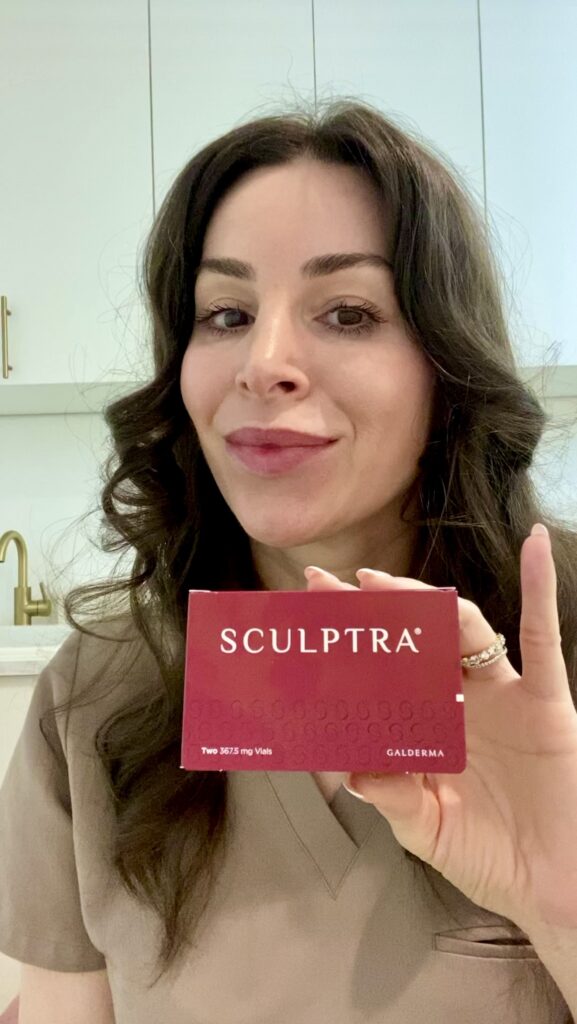
Written by Korosh Borhani, D.O., board-certified emergency physician and Medical Director of Skin Bio. Clinically reviewed September 10, 2026. This article is educational and is not a substitute for a consultation. Instagram: @DrKoroshBorhani
“Biostimulator” is a marketing word. I use it too, because that’s what patients call these products, but I want to walk you through what’s actually happening under the skin, the same way I’d explain it to a buddy at the gym who asked. Because with these particular products, understanding the biology is the difference between a result you love and a lump you can feel for a year.
Here’s the science in plain language, the timelines that are actually realistic, who I think these are for, and the fine print the before-and-after photos leave out.
The short version
When I inject Sculptra, I’m placing tiny particles of poly-L-lactic acid, the same material used in dissolvable stitches, into the deep layer of the skin and just under it. Your immune system notices. Cells called macrophages show up, check out the particles, and can’t break them down quickly. What follows is a controlled, low-grade reaction to a foreign body: the macrophages call in fibroblasts, and fibroblasts do what fibroblasts do, which is build collagen. Over the next several months the PLLA slowly breaks down into lactic acid and gets cleared. What’s left is a scaffold of new collagen, mostly type I, laid down in the pattern of the injections.
Radiesse works on the same idea with a different particle: calcium hydroxylapatite, chemically close to the mineral in your bones, suspended in a gel. The gel gives you some lift right away, which Sculptra doesn’t, and the particles drive the same collagen response while the gel gets absorbed over the next few months.
So when a patient tells me at her two-week check that Sculptra “did nothing,” my answer is that it wasn’t supposed to yet. At two weeks, the water it was mixed in is long gone and the collagen hasn’t been built. This is the single most important thing to understand going in, and it’s why I won’t treat someone with a wedding in six weeks with a biostimulator alone.
Biostimulators do their best work in a specific person: somebody in their late thirties to sixties with early or moderate volume loss through the temples, cheeks and jawline, skin that’s lost some thickness, and a preference for “you look well” over “you look done.” They’re great in men, whose faces often don’t wear filler well but take to biostimulators nicely. Hyperdilute Radiesse, used off-label, is one of the better tools we have for crepey skin on the neck, chest, arms and knees, where the problem isn’t volume but skin quality.
They also fit the way we think about regenerative medicine at Skin Bio: get the body’s own repair crew to do the work instead of parking a foreign material where a structure used to be.
This is the part of the consult where I earn my paycheck, because I say no to biostimulators more than almost anything else we do.
Not sure whether you’re a biostimulator candidate? This is one of the treatments where a physician’s look changes the recommendation more often than not.
The complication that matters with Sculptra is the nodule: a small firm bump under the skin that you can feel and sometimes see. In the early years the reported rates were uncomfortably high. They’ve come way down, and the reason is technique, not a change in the product.
Three things drive the nodule rate down. First, dilution: mixing the vial with more sterile water, plus a little lidocaine, than the original directions called for, so the particles are spread thin. Second, depth: PLLA belongs deep, in the fatty layer, never up in the surface of the skin. Third, massage. After treatment we ask you to massage the area for five minutes, five times a day, for five days, the “5-5-5” rule, to spread the particles out before they settle. Patients who skip the massage show up more often among the patients who get lumps. I say that gently, and I mean it.
Radiesse carries a lower nodule risk in the face but has a rule of its own: it never goes in the lips, and it’s a poor choice for very thin skin.
Both products share one fact that hyaluronic acid filler doesn’t: there’s no enzyme that dissolves them. Hyaluronidase, the reversal drug for HA filler, does nothing for PLLA. Nodules can be treated, with saline or steroid injections and sometimes a minor procedure, and they usually resolve, but “usually” is not “right away,” and that belongs in your decision.
| Hyaluronic acid filler | Sculptra / Radiesse | |
|---|---|---|
| What it does | Adds volume where it’s placed | Builds your own collagen over months |
| When you see it | Right away | Six to twelve weeks, building over months |
| How it looks | Volume and contour | Skin thickness, structure, a “rested” look |
| Reversible? | Yes, with hyaluronidase | No |
| Sessions | Usually one | Usually two or three |
| Duration | Six to eighteen months depending on product and area | Roughly two years (Sculptra), twelve to eighteen months (Radiesse) |
A lot of my patients end up with both: a little HA where a precise contour matters, biostimulator for the broad, structural change. Done conservatively, that combination is most of what “she looks great and I can’t tell why” actually is.
We mix it with lidocaine and use numbing cream, so most people describe pressure more than pain. The face feels full and a little tender for a day or two.
Depends on your age, your face and how much volume you’ve lost, and anyone who quotes a number before examining you is guessing. A common starting point for a full face is one to two vials per session over two or three sessions.
Yes, and it often is. We usually space them out rather than doing everything the same day, so we can judge each result on its own.
Neither is better; they’re different tools. Radiesse gives some immediate structure and is my preference for the jawline and, diluted, for skin quality on the body. Sculptra is my preference for broad, gradual rebuilding in the temples and cheeks.
Any treatment that works by getting your own tissue to repair or rebuild instead of adding a material that stays. Biostimulators qualify; so do platelet-based treatments and the cellular therapies we work with through Bio Bank.
Sources and further reading
Follow along on Instagram: @DrKoroshBorhani and @skinbio.co
This article is educational and reflects the author’s clinical opinion. It is not individual medical advice. Biostimulator treatment requires evaluation by a licensed medical provider; results and risks vary.

Consultations at Skin Bio are with a physician or nurse practitioner — not a salesperson. We’re in Calabasas and see patients from across the greater Los Angeles area.
Or call 818.222.9797