Home Blog News & Events Before I Was a Nurse Practitioner, I Was an Opera Singer
Instagram: @DrKoroshBorhani·@CristinaBorhani_NP·@skinbio.co
Written by Cristina Borhani, MSN, NP. Medically reviewed by Korosh Borhani, D.O., board-certified emergency physician and Medical Director of Skin Bio. Last reviewed November 1, 2026.
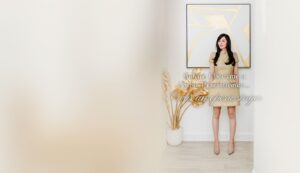
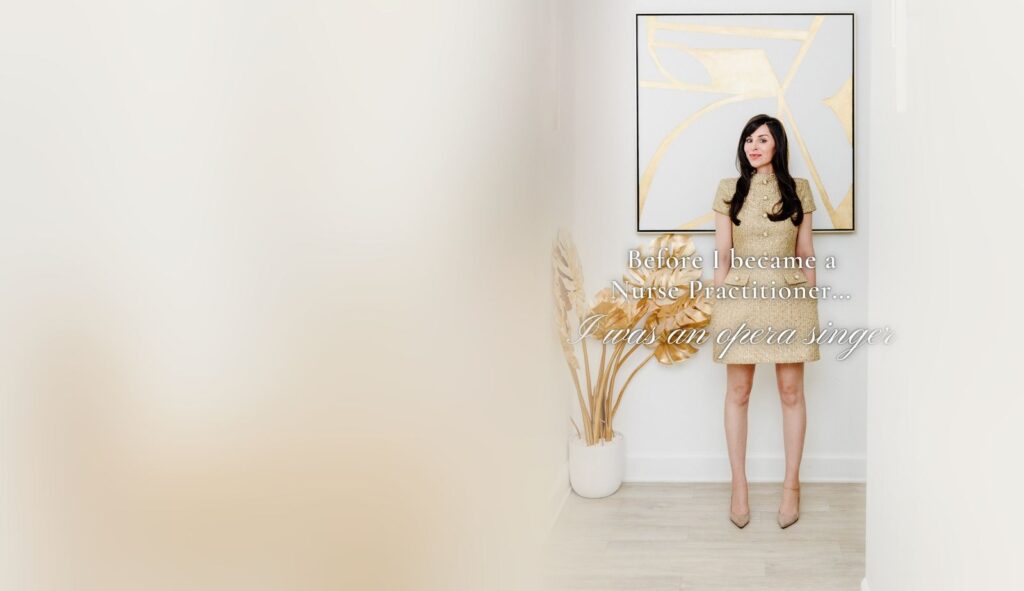
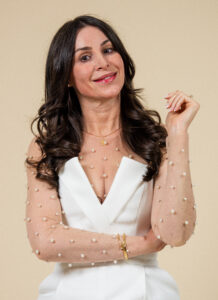
Before I became a nurse practitioner, I was an opera singer. I studied Vocal Arts and Opera at the USC Thornton School of Music, which means I spent years learning that the instrument is you — your ribs, your diaphragm, the two small folds of tissue in your larynx that come together and vibrate a few hundred times a second when you sing an A above middle C.
People find the career change strange. I never have. I went from studying one kind of anatomy to studying another, and both jobs come down to the same thing: understanding a living structure well enough to work with it instead of against it.
The short version
A voice is a physical act. Air moves out of your lungs, your vocal folds interrupt that airflow into pulses, and the shape of your throat, mouth and sinuses turns those pulses into a sound that reaches the back of a hall with no microphone. Everything a singer does in a practice room for years is about controlling muscles most people never consciously use.
Voice training made me permanently attentive to structure. You learn to hear the difference between a sound supported from the body and one being forced at the throat, and you learn that forcing it causes damage. You learn you cannot rush tissue. A voice pushed too hard too young develops nodules, and the fix is rest and technique, not more effort.
I think about that constantly in the treatment room. The patients who get into trouble with aesthetic medicine are nearly always the ones who pushed — more product, more often, chasing a result the tissue was never going to give them. Restraint is the hardest thing to teach in both fields, and in both fields it is most of the job.
Singing also gave me a tolerance for critique. A voice lesson is an hour a week of someone telling you precisely what was wrong with the thing you just did. That turns out to be useful preparation for clinical training, and for running a business.
On October 17 we did something I had wanted to do for years. After our surgical consultation day with Dr. Leif Rogers, we opened the practice from five to six thirty for an evening built around live singing, for our Bio Bank members and consultation day guests.
Live opera in a medical office reads strangely on paper. In the room it was not strange at all. There were bubbles and bites, psychic readings, gift bags, a giveaway, a dress code I described as gilded neutrals, and a crowd of people who mostly already know each other. Then someone stood up and sang, unamplified, about fifteen feet from where I inject patients every week.
Our performer was Mariah Schaumberg, an American lyric soprano from Milwaukee. She earned her Bachelor of Music in Vocal Performance at Lawrence University and is completing her Master of Music in Vocal Arts and Opera at USC Thornton.
Her credits already run from the repertoire everyone knows to work most audiences never get to hear: Violetta in La traviata, Gilda in Rigoletto, Magda de Chevry in La rondine, Magda Sorel in The Consul, the Governess in The Turn of the Screw. After La rondine with Pacific Opera Project, she takes on Diana and Giove in La Calisto with USC Thornton Opera — the final production of her collegiate career.
That last detail is the one I keep returning to. She is at the end of the training and about to walk into the industry. Inviting a Thornton student was deliberate: that school trained me, and the students there now are doing the same unglamorous work I did, mostly alone in a practice room, in a field that is changing underneath them considerably faster than it changed underneath me.
This is the part I actually care about.
Generative models can now produce singing that most listeners cannot distinguish from a trained human voice, including convincing imitations of specific, identifiable artists. That is not a forecast. It is a working product, and the industry has spent the last couple of years scrambling to respond.
In 2024 more than two hundred artists signed an open letter asking AI developers and technology companies to stop using their work to train systems that would then replace them. The same year Tennessee passed the ELVIS Act, the first state law in the country written specifically to address AI voice impersonation of musicians, extending that state’s right-of-publicity protections to cover a performer’s voice. Further proposals have followed at the federal level. Serious people are treating this as a serious threat, and they are right to.
What concerns me most sits further upstream, in the training. A conservatory degree in vocal performance costs an enormous amount and takes the better part of a decade to pay back, if it ever does. Every young singer weighing that now has to ask whether the thing she is training to do will still be a job. Some will decide it will not be. Some of those would have been extraordinary.
I do not think a model replaces what happens in a live room, and I say that as someone who has stood on both sides of it. Part of what moves an audience is knowing the sound is costly — that it comes out of one specific body, under real physical strain, in real time, and that it could fail. Perfection was never the point. Presence is.
But “it cannot be replaced” is a comfortable thing to believe and a dangerous thing to assume. Markets do not reliably reward the real thing over the convincing one. If nobody pays for live performance, there is no career to train for, whatever a model can or cannot do. Which is part of why we put a soprano in our treatment room instead of a playlist.
Our Bio Bank members get first access to evenings like this one.
Membership carries member pricing on treatments and medical-grade skincare, a complimentary skin analysis with 3D imaging, a complimentary wellness consultation, and invitations to members-only events.
Because it is the same question aimed at a different part of the body.
I work on faces at a moment when most people’s reference image for a face is not a face. It is a filtered photograph, a smoothed video, or increasingly an image no person ever stood in front of a camera for. Patients bring me those pictures. They are asking for something that does not exist and never existed on anyone.
The honest work in my field is the same as the honest work in music: helping something real become the best version of itself, rather than replacing it with a simulation that is cheaper to produce. I would rather you look like a well-rested version of yourself at fifty-five than like a rendering of a person who is not you. That is a position, and not everyone in aesthetics shares it.
Protecting the art of the human voice and protecting a human face from being flattened into a template are, to me, the same instinct. I did not expect my two careers to end up arguing for the same thing. They do.
We will do this again. The format works, the room sounds better than it has any right to, and there is something clarifying about watching a young singer stand up and do a difficult thing beautifully with no technology between her and the people listening.
Evenings like this are a Bio Bank benefit, alongside the member pricing and complimentary services that make the membership worth holding year-round. If you want to be in the room next time, join the Bio Bank or call us at 818.222.9797 and we will walk you through how it works.
Bio Bank is our membership program. It includes member pricing on treatments and medical-grade skincare, a complimentary skin analysis with 3D imaging, a complimentary wellness consultation, and invitations to members-only events like An Evening at the Opera. Current terms are on our Bio Bank page, or call 818.222.9797.
Yes. I studied Vocal Arts and Opera at the USC Thornton School of Music before going to nursing school, and I have been practicing as a nurse practitioner for more than sixteen years.
A members-only reception at our Calabasas office on October 17, 2026, from five to six thirty, with live opera, bubbles and bites, psychic readings and gift bags. It followed our surgical consultation day with Dr. Leif Rogers the same afternoon.
We host several a year, most of them for Bio Bank members. The guest lists are deliberately small, which is part of why an unamplified voice works in the space.
Generative models can now produce convincing synthetic singing, including imitations of specific artists. Musicians have responded with open letters to AI developers and with legislation such as Tennessee’s ELVIS Act, which addresses AI voice impersonation. The longer-term concern among performers is what it does to the economics of training a voice at all.
Soprano Mariah Schaumberg, who is completing her Master of Music in Vocal Arts and Opera at USC Thornton after earning her Bachelor of Music in Vocal Performance at Lawrence University.
Sources and further reading
This article is a personal essay and is educational only. It is not individual medical advice. Any aesthetic treatment requires evaluation by a licensed provider who can assess your anatomy, history and goals. If you would like to discuss treatment, get in touch.
Consultations at Skin Bio are with a physician or nurse practitioner — not a salesperson. We’re in Calabasas and see patients from across the greater Los Angeles area.
Or call 818.222.9797