


Home Blog Wellness & Hormones IV Drips: What an ER Physician Actually Thinks About Vitamin Infusions
Instagram: @DrKoroshBorhani·@CristinaBorhani_NP·@skinbio.co

Written by Korosh Borhani, D.O., board-certified emergency physician and Medical Director of Skin Bio. Clinically reviewed September 10, 2026. Instagram: @DrKoroshBorhani
I’ve hung more bags of IV fluid than I could count. In the emergency department a liter of saline is a tool with a job: the guy who’s been throwing up for two days, the diabetic in crisis, the grandmother whose blood pressure is dropping. It’s never a treat. So when I look at the “IV drip lounge” business, I come at it with a working man’s skepticism, and I want to explain that honestly, because we offer IV therapy at Skin Bio and I think you deserve to know exactly what you’re buying.
The short version
Your gut is a very good absorber of water and most vitamins. In a healthy person who eats and drinks normally, an IV dose of vitamin C or the B vitamins mostly bumps the blood level for a little while, and then the kidneys clear the extra. The old joke about expensive urine is a joke because it’s mostly true for water-soluble vitamins in people who aren’t deficient.
Where the IV route really changes things is when the gut is out of the picture or the shortage is real: the patient who can’t keep fluids down after a stomach bug, the person who’s badly dehydrated after a day in the heat or a long flight and a late night, the patient with a documented B12 or iron deficiency who isn’t absorbing pills, the migraine patient for whom IV magnesium and fluids are part of a plan. Those are real reasons. I use them in the hospital and I’m comfortable using them at the practice.
The best-known wellness infusion is the Myers’ cocktail, a mix of magnesium, calcium, B vitamins and vitamin C that’s been around for decades. The most careful study of it I know of was a small randomized, placebo-controlled trial in patients with fibromyalgia. Both groups got better. There was no meaningful difference between the cocktail and the placebo bag. That’s one small study, and it doesn’t prove the cocktail is worthless, but it does mean the confident claims on lounge menus aren’t coming from the data.
The claims I’d ask you to be most skeptical of:
The Federal Trade Commission and the Food and Drug Administration have both sent warning letters to IV therapy businesses over unsupported health claims. When the regulators and the ER doctor agree on something, it’s worth a listen.
An IV is a needle in a vein hooked to a bag of fluid. Done carefully by a trained nurse, the risks are small. They aren’t zero, and they aren’t the same for everybody.
Thinking about IV therapy? At Skin Bio every IV starts with a medical evaluation, and we’ll tell you straight if you don’t need one.
In California, IV therapy is the practice of medicine. Before you get one, a physician, nurse practitioner or physician assistant has to evaluate you and order it. A registered nurse can then place the line and run the infusion under that order and under physician-approved protocols. An unlicensed “wellness technician” can’t, and a nurse can’t decide on her own that you’re a candidate. Mobile services and storefront lounges are held to the same standard as a clinic.
So the test is simple. If you can walk in, point at a menu, and get hooked up without anyone who can prescribe ever evaluating you, that business isn’t following the rules. And in this case the rule isn’t paperwork. It’s the step where somebody notices you have a heart condition.
A physician or nurse practitioner evaluates you first, including the questions about heart, kidney and liver disease, medications, pregnancy, and, before any high-dose vitamin C, your G6PD status. Our nurses place the lines. We keep emergency medications on hand. We use formulas for specific reasons: hydration and electrolyte replacement, B12 for a documented deficiency, magnesium for patients whose physicians agree it makes sense. We don’t promise any of it will detox you, cure a hangover, or make you immune to anything.
If what you really need is a glass of water and a night’s sleep, I’ll tell you. I’ve told people. It’s the least profitable sentence in this business, and I’m fine with that. I’d rather be the guy in Calabasas you trust than the guy who sold you a drip.
For true dehydration, documented deficiencies and certain specific conditions, yes, because they deliver fluid and nutrients the gut isn’t delivering. For general wellness in a healthy person, the evidence is weak, and most of the vitamin ends up in your urine.
Generally, when a trained nurse gives it after a medical evaluation. It’s unsafe for people with heart failure or significant kidney disease, and high-dose vitamin C is dangerous for people with G6PD deficiency. Clean technique and an emergency plan matter.
There’s no medical reason for a healthy person to get one on a schedule. If you feel like you need weekly infusions to function, that’s a reason to see a physician for a workup, not a reason for a membership.
It can ease the dehydration and nausea, which is most of how a hangover feels. It doesn’t reverse alcohol’s effects or protect your liver.
A physician, or a nurse practitioner, physician assistant or registered nurse under physician supervision, after a physician, NP or PA has evaluated you and ordered the treatment.
Sources and further reading
Follow along on Instagram: @DrKoroshBorhani and @skinbio.co
This article is educational and reflects the author’s clinical opinion. It is not medical advice for any individual. IV therapy requires evaluation by a licensed medical provider; risks vary with your health history.

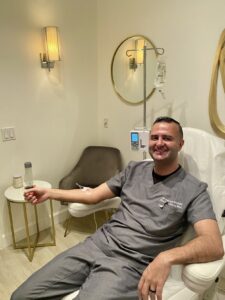

Consultations at Skin Bio are with a physician or nurse practitioner — not a salesperson. We’re in Calabasas and see patients from across the greater Los Angeles area.
Or call 818.222.9797